
New England Weavers' Seminar: 2027 Workshops
Filter By
J-4
Exploring Twills on a Rigid Heddle Loom
Instructor:
Duration:
Start Date:
End Date:
Experience Level:
Cost:
Materials Fee:
Katie Strano
1 day
Friday, July 30, 2027 at 12:30:00 PM UTC
Friday, July 30, 2027 at 8:30:00 PM UTC
Intermediate/advanced
$160.00
$10.00

In this class, weavers will learn how to dress their looms for a twill sampler. We will use two rigid heddle reeds
to create 3/1 twills using three different threadings. We will then explore various weaving sequences to create
a variety of twill patterns. We will discuss how a three-shaft twill pattern can be converted into a rigid heddle
pattern. We will also touch on how four-shaft twills can be woven on a rigid heddle loom using three reeds, and
there will be a demo loom set up for weavers to try this more complex method. Students will leave class with a
woven twill sampler to inspire future projects.
Supply List
Equipment Needed:
● Rigid Heddle Loom
● Two Rigid heddle Reeds of the same dpi. Preferably two 7.5 dpi or 8 dpi, depending on loom
manufacturer, but two 10 dpi could would as well.
● At least one stick shuttle
● Sley hook/threading tool
● Scissors
● Warping peg and loom clamps
Yarn Needed to Bring:
● Warp yarn: 336 yards of yarn that can be comfortably placed at a set in the range of 10-12 ends per
inch. Choose something that isn’t too sticky since it will have to be traveling through two reeds with
multiple pieces of yarn through one dent. (If using 10 dpi reeds, choose yarn that can be placed at
12-15 epi)
● Weft yarn: 220 yards of yarn in a different color from the warp. Stash busting is encouraged here.
Provided by Instructor
Students will receive an in-depth handout with step-by-step color pictures and instructions.
K-2
Bobbin Lace Bijoux
Instructor:
Duration:
Start Date:
End Date:
Experience Level:
Cost:
Materials Fee:
Carolyn Wetzel
1 day
Saturday, July 31, 2027 at 12:30:00 PM UTC
Saturday, July 31, 2027 at 8:30:00 PM UTC
Beginner
$160.00
$10.00

In this class you will fabricate a strip of bobbin lace, with or without beads, that can be made into a lovely bijou: a bracelet, key ring strap, or clothing adornment. By doing this simple project you will learn how to wind the bobbins, prepare the pattern, dress the lace pillow, and use basic bobbin lace techniques. Open to beginners and beyond, with pattern choice based on experience level.
Supply List
*The instructor will send a more detailed description of tools and supplies well in advance of class, including inexpensive DIY options.* Thread: 1-3 colors of size 40 crochet cotton (such as Lizbeth), approx. 2 yards per pair of bobbins; 16 (8 pairs) of lace bobbins; Bobbin lace pillow, 16-20 inches diameter (flat, slightly domed, or roller style); 0.6mm crochet hook (steel hook size 12); Straight pins: Approx.150 #17 Satin or silk pins, or any small-head straight pin about 0.6 - 0.7 mm dia x 26-38 mm long; Corsage or ball-head straight pins: 3 or 4 of these for general use; 1 cover cloth (fine woven dishtowel or quilt fabric fat quarter will work); Non-skid pad (e.g., rubberized shelf liner) to put under the lace pillow; Pin cushion; Thread scissors; Pin vise with #8-9 sharp needle inserted. If you don’t have one, you can use a corsage pin for the same purpose. Don’t buy one for class, wait until you see the options that are specific for lace makers; Portable light and extension cord or extra batteries; Magnifier if you usually need one for needlework.
Provided by Instructor
Handouts, pattern, seed beads, metallic threads, findings for bracelet or key fob.
K-3
Tablet Weaving: Two-sided Delights
Instructor:
Duration:
Start Date:
End Date:
Experience Level:
Cost:
Materials Fee:
John Mullarkey
1 day
Saturday, July 31, 2027 at 12:30:00 PM UTC
Saturday, July 31, 2027 at 8:30:00 PM UTC
Some tablet weaving experience
$160.00
none

Have you ever wished you could weave almost any design into a woven band? Or how about weaving a message without pick-up? Double-sided tablet weaving is for you then. This technique creates a two-color band with almost any figure or letters woven into it. This technique does require focus and concentration to weave however, as we will be following charts to turn individual cards to produce patterns.
Supply List
Inkle style loom (Note: Ashford Inklet is too small for tablet weaving), 20 4-hole cards, belt shuttle, scissors, four balls or cones of 5/2 to 10/2 mercerized or unmercerized cotton or #10 crochet thread. Each ball should be at least 1 ounce. Two balls of one color, and two balls of one different highly contrasting color. There will not be time in class to wind off, so please come prepared with four yarn sources.
Provided by Instructor
NA
N-1
Weaving a Three-Dimensional Mask with Manipulated Warps
Instructor:
Duration:
Start Date:
End Date:
Experience Level:
Cost:
Materials Fee:
Linda Rhynard
1 1/2 days
Saturday, July 31, 2027 at 12:30:00 PM UTC
Sunday, August 1, 2027 at 3:30:00 PM UTC
Beyond beginner- intermediate and above
$240.00
$30.00
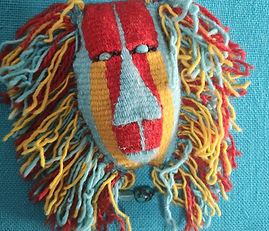
This workshop is for people who are comfortable with basic Tapestry techniques and warping the loom. The mask is woven using basic Tapestry Techniques along with a pulled warp method of shaping. This project will be woven on small wooden frame looms, woven flat and then manipulated into shape. Warp and Weft yarn will be provided. Goal of the Workshop: We will talk through the process, warp the loom and begin weaving the mask. At the end of the session, we will remove the mask from the loom and manipulate that warp threads to create the three-dimensional shape. We will also discuss finishing and mounting options. Examples will be available for review and discussion.
Supply List
If you have a personal small weft beater ( two inch wide or so,) and stick shuttles (6-8”) feel free to bring to class.
Provided by Instructor
Looms, warp and weft, instruction packet. Basic tools to be used- scissors, rulers, Pen/pencil- paper for notes * (2) 1.5-inch cardboard spacers (to support your beginning weaving).* Shuttles or bobbins for weft”,*pick up
stick, beater
N-2
Doubleweave Blanket on a Rigid Heddle Loom
Instructor:
Duration:
Start Date:
End Date:
Experience Level:
Cost:
Materials Fee:
Katie Strano
1 1/2 days
Saturday, July 31, 2027 at 12:30:00 PM UTC
Sunday, August 1, 2027 at 3:30:00 PM UTC
Intermediate
$240.00
$10.00

In this class, students will weave a small throw blanket on a rigid heddle loom. We will use two rigid heddle
reeds and pickup sticks to weave two layers of cloth simultaneously, which are connected on one side,
creating a piece of cloth that is double the width of your warp. We will also discuss and go over the variations
on doubleweave that can create a tube, woven slits, and two separate layers. Students should arrive to class
with an empty loom as we will all be warping and preparing the looms together. Please note that we will warp
the loom and learn the doubleweave shuttle sequence, and discuss finishing techniques. However, weaving
double-width is a slow process, and students will then take their looms home to finish weaving the blanket at
their own pace.
Supply List
● WARP: 600 yards (300 yards each of two contrasting colors) of any yarn of your choice
that works with a plainweave sett of 7-8 epi.
● WEFT: 390 yards (195 yards each of the same two yarns as in the warp)of your choice.
● Rigid heddle loom with a weaving width of at least 20”
● Two 7.5 dpi (or 8 dpi, depending on the manufacturer) rigid heddle reeds
● Two pickup sticks – appropriate for weaving at least 20” wide
● Two stick shuttles – at least the weaving width of the cloth
● Sley hook/threading hook
● Warping peg
● Scissors
● Scrap yarn, fabric strips, warping sticks, or your preferred material for the header and footer.
Provided by Instructor
An in-depth 18 page color printed handout with the pattern and detailed step-by-step instructions for preparing
the loom for doubleweave. Students need to bring their own yarn, loom, and weaving equipment.
P-1
Suminagashi and Asian Style Stab Books
Instructor:
Duration:
Start Date:
End Date:
Experience Level:
Cost:
Materials Fee:
David Heustess
2 days
Friday, July 30, 2027 at 12:30:00 PM UTC
Saturday, July 31, 2027 at 8:30:00 PM UTC
none
$320.00
$15.00

On day one, you will explore the art of Suminagashi, water marbling, and create your own designs on paper, fabric and other materials. Day two you will learn three basic stitching patterns of Asian Style Books (soft covered) and then explore how to create your own patterns to stitch. Marbled fabricsabrics can be used to make quilts, covers for hard bound books, scarves, strip weaving etc.
Supply List
notebook, pen/pencil, scissors, 12" ruler
Provided by Instructor
Sumi inks and supplies for vats, use of paper cutter, paper, fabric, needles, thread, awls
P-2
Three-dimensional Ply-Splitting
Instructor:
Duration:
Start Date:
End Date:
Experience Level:
Cost:
Materials Fee:
Rebecca Jensen
2 days
Friday, July 30, 2027 at 12:30:00 PM UTC
Saturday, July 31, 2027 at 8:30:00 PM UTC
Prior experience w/ ply splitting desirable but not required.
$320.00
$30 –$ 60 depending on project size.

Ply-splitting started with camel herders spinning goat hair into cords that they then used to fashion girths for saddles and packs. Today artists use a variety of materials to make not only flat pieces, but also three-dimensional ones. You’ll start your three-dimensional explorations with a simple item using only four cords and plain oblique twining (POT). Moving on, you’ll practice your single course oblique twining (SCOT) skills to make a basket. Finally, you’ll use both POT and SCOT to create a three dimensional item with bumps and curves, oh my. The path to a finished product is unique to the maker. Come develop your skills as you are exposed to different ply-splitting materials, techniques and ideas.
Supply List
Scissors. Paper and writing implement for note taking. A 4.5mm gripfid (may be purchased or borrowed in class).
Provided by Instructor
Materials fee covers prepared cords and handouts. Gripfids may be borrowed from the instructor, or purchased for $10.
P-3
Flax & Hemp to Linen
Instructor:
Duration:
Start Date:
End Date:
Experience Level:
Cost:
Materials Fee:
Andrea Myklebust
2 days
Friday, July 30, 2027 at 12:30:00 PM UTC
Saturday, July 31, 2027 at 8:30:00 PM UTC
No experience needed
$320.00
none

In this hands-on workshop, we will explore all of the steps involved in growing, processing, and spinning flax and hemp for weaving. On day one, we will discuss fiber flax and hemp seed selection, current licensing requirements for growing hemp, and how to grow, harvest, and ret these plants for fiber use. We will have retted straw on hand to process straw with brakes, scutching knives and hackles, and participants will have plenty of time to try their hand at using these traditional tools to process bast fibers. On day two, we will learn how to dress a distaff for spinning long line fibers, and will spend the day spinning both line and tow, as well as learning how to finish our handspun yarns in the scouring process. Spinners are welcome to bring their own wheel, spindle, and distaff if they have them. No prior spinning experience required.
Supply List
If you have a working spinning wheel or hand spindle, and a distaff, you are welcome to bring them.
Provided by Instructor
Instructor will provide all of the materials required for the workshop.
P-4
A New Spin on Color: 12 Ways to Work with Hand-Painted Fiber
Instructor:
Duration:
Start Date:
End Date:
Experience Level:
Cost:
Materials Fee:
Alanna Wilcox
2 days
Friday, July 30, 2027 at 12:30:00 PM UTC
Saturday, July 31, 2027 at 8:30:00 PM UTC
Advanced-Beginner to Intermediate
$320.00
$18.00

Based on the concepts from her book A New Spin on Color, Alanna will help you develop a deeper understanding of color and show you how to apply that knowledge to create more intentional handspun yarns. If you've ever wondered why some color combinations seem to sing while others become muddy or disappointing, this workshop will help you understand what's happening and give you practical tools for making more confident color decisions. You'll begin by exploring color theory through a fiber artist's lens, creating carded color blends and learning how to use photographs as inspiration for future projects. From there, you'll discover how different approaches to spinning colored and hand-painted fiber can dramatically change the appearance of the finished yarn. Throughout the workshop, Alanna will show you how preparation, drafting, color placement, yarn structure, and plying choices influence the final result. You'll compare samples side by side, experiment with multiple approaches to the same fiber, and discover how knitting, weaving, and crochet each influence the way color appears in fabric. You'll leave with a collection of samples, practical color tools you can apply to future projects, and greater confidence in your ability to work intentionally with color from inspiration photo to finished fabric. Students will have the opportunity to create pin loom swatches during class to evaluate how their yarn behaves in fabric. Students may bring their own pin loom or purchase one from Alanna for an additional $50. Students wishing to purchase a loom should contact Alanna no later than one month before the conference so sufficient looms can be ordered.
Supply List
• Working spinning wheel or e-spinner in good working order • Oil and wheel maintenance tools appropriate for your wheel • At least 3 empty bobbins • Lazy kate • Usual spinning tools and supplies • Notebook or method of taking notes • Optional: hand cards or blending tools if you already own them, knitting needles, crochet hook, pin loom
Provided by Instructor
• Hand-painted fiber for sampling exercises • Additional prepared fiber samples • Handouts and reference materials
Q-1
Beyond Four Shafts: Designing for Eight Shaft Summer and Winter
Instructor:
Duration:
Start Date:
End Date:
Experience Level:
Cost:
Materials Fee:
Jill Staubitz
2 1/2 days
Thursday, July 29, 2027 at 12:30:00 PM UTC
Saturday, July 31, 2027 at 3:30:00 PM UTC
Participants should have prior experience weaving Four Shaft Summer and Winter, be comfortable with using more than one shuttle and weaving using skeleton tie ups. This class is meant for Jack Looms and table looms only. (Countermarche looms won’t work due to the skeleton tie ups necessary to achieve six blocks).
$400.00
$20.00

This workshop is a game changer for weavers with the desire to design their own patterns in Summer and Winter. You’ll learn why Summer and Winter is a block weave AND a unit weave, making it a perfect weave structure for designing with six blocks on eight shafts! You’ll create colorful patterns and motifs from profile drafts and weave them in class. Participants will design a gamp with their own creations, including a portion of the gamp woven in polychrome, based on a foundation draft that I will send out prior to the workshop. FiberWorks or other weaving software is welcome but not mandatory.
Supply List
8 shaft floor or table loom, (NO countermarche), prepped and ready to weave at the beginning of class. A variety of weft yarns in various colors and weights. I am hoping that weavers will pool their yarns so that all can share weft yarns. At least 2 shuttles, ideally three or more for weaving polychrome. (Extra Stick shuttles will do for polychrome). Graph paper, pencils, extra warp for repairing broken ends. Weaving software is welcomed, but not essential. Bobbin winders will be needed so please be willing to share yours!
Provided by Instructor
Prior to class, I will send out a draft for participants to dress your looms ready for class. In class, I will distribute a thorough booklet for you to follow along in class that will aid you in creating your own designs. The booklet will be most handy to keep in your weaving library for future reference.
NEWS is grateful to WEBS for lending looms and equipment to NEWS for the Beginners class, including transportation, set-up, and technical help. WEBS has been a long-time supporter of NEWS and a champion in support of our educational mission.